***この固定ページでは、連載『切り替えの物語 — AIとの対話から生まれた統合理論』で扱った内容を学術的な形でまとめた論文5を掲載しています。なお、論文中で使用した数式の正しい表記については、論文最後尾の(注)をご参照下さい。***
論文タイトル
歩行—走行切り替えにおける制約幾何学と階層的再編成: SCAN・VSM・3D 最小モデルを統合する枠組み
要旨(Abstract)
歩行から走行への移行に代表されるように、行動モードの切り替えは、生物・認知・組織など多様なシステムに普遍的に見られる現象である。しかし、既存の説明は、力学系理論、階層的組織モデル、制約最適化、運動変動性分析など、異なる研究伝統に分断されてきた。
本研究では、先行する4本の論文に基づき、SCAN、VSM(Viable System Model)、制約幾何学、3D最小モデルが、切り替え現象に適用した際に 共通の5段階構造 を持つことを示す。これらの理論は表現形式こそ異なるものの、いずれも「不安定化 → 自由度の増大 → 境界領域の通過 → geodesic 的遷移 → 再安定化」という同一の構造を記述している。
この構造的同値性に基づき、本論文は 統合理論(Unified Switching Theory) を提案する。本理論は、 (1) タスク非関連方向の変動性(Var⊥)の増大、 (2) 境界領域(liminality)の通過、 (3) 新たな安定状態へ向かう geodesic 的遷移 という3つの原理により、切り替え現象を一般的に説明する枠組みである。
本統合理論は、歩行→走行切り替えのみならず、運動協調、組織再編、認知モードの切り替えなど、多領域にわたる現象を統一的に説明できる。これにより、複雑システムがどのように再編成し、適応し、モードを切り替えるのかを理解するための、領域横断的かつ一般性の高い基盤を提供する。
📘 第1章 序論(Introduction)
行動モードの切り替えは、生物、認知、組織といった多様なシステムに広く見られる普遍的な現象である。人間の歩行運動はその典型例であり、歩行速度が増加すると、ある特徴的な臨界速度で歩行から走行へと自発的に切り替わる。この現象は数十年にわたり研究されてきたが、既存の説明は力学系理論、運動制御、階層的組織理論、制約に基づく最適化など、複数の理論的伝統に分断されている。それぞれの枠組みは切り替えの重要な側面を捉えているものの、 「なぜ切り替えが起こるのか」「どのように進行するのか」「どのような構造原理が領域を超えて保存されるのか」 を包括的に説明するものは存在しない。
先行研究である論文1〜4では、歩行から走行への切り替えを以下の4つの異なる理論的視点から分析した:
①SCAN(looseness–liminal–re-stabilization)
制御の緊密性の低下、境界領域への突入、新たな安定モードの出現という3段階構造を強調する。
②VSM(階層構造の崩壊と再編成)
タスク要求の増大に伴う機能的階層の崩壊と、新たな階層構造への再編成として切り替えを捉える。
③制約幾何学(最適面と geodesic 的遷移)
切り替えを、最適面の拡張と、その内部を通る最短経路(geodesic)として記述する。
④3D最小モデル(アトラクタ浅化・Var⊥増大・遷移軌道)
最小3次元状態空間におけるアトラクタ浅化、タスク非関連方向の変動性(Var⊥)の増大、鞍部を通る遷移軌道として説明する。
これら4つの枠組みは一見すると異なる理論的背景を持つが、切り替え現象を記述する際には驚くほど類似した構造を示す。いずれの枠組みも、 (i) 現在のモードの不安定化、 (ii) 利用可能な自由度の拡大、 (iii) 境界領域の通過、 (iv) 新たな安定構造への遷移、 という共通のプロセスを描いている。
本論文(論文5)の目的は、この深い構造的共通性を形式化し、統一的な理論枠組としてまとめ上げることである。 本論文は単なる比較ではなく、4つの枠組みが同一の基盤構造を異なる角度から表現していることを示し、その構造を一般化した 「統合切り替え理論(Unified Switching Theory)」 を提案する。
本論文の貢献は以下の3点にまとめられる:
a)構造的統合
SCAN、VSM、制約幾何学、3D最小モデルが、共通の5段階切り替え構造を持つことを示す。
b)統合切り替え理論の提示
Var⊥(タスク非関連方向の変動性)と geodesic 的遷移を中心とした一般理論を定式化する。
c)領域横断的適用可能性の提示
歩行→走行切り替えにとどまらず、運動協調、組織再編、認知モード切り替えなど、多様な領域に適用できることを示す。
本論文は、構造・幾何・力学の視点を統合することで、切り替え現象の普遍的理解に向けた基盤を提供する。
📘 第2章 基礎(Preliminaries)
本章では、本論文で展開する統合切り替え理論の基盤となる4つの理論枠組を整理する。目的は、これらの理論を包括的にレビューすることではなく、第3章の構造的同値性の議論および第4章の統合理論の定式化に必要な最小限の構造を、共通の記法のもとで明確化することにある。
本章を通して、タスク関連(task-relevant: TR)次元とタスク非関連(task-irrelevant: TI)次元の区別、そしてそれらに沿った変動性の扱いを統一的に記述するための記法を導入する。
2.1 SCAN:ゆるみ・境界領域・再安定化
SCAN は切り替えを以下の3段階として捉える:
Looseness(ゆるみ)
現在のモードにおける制御の緊密性が徐々に低下し、特にタスク非関連(TI)方向の変動性が増大する。これは既存アトラクタの弱体化を反映する。
Liminality(境界領域)
システムはもはや現在のモードに完全にはコミットしておらず、複数の潜在的モードが共存しうる領域に入る。制御は分散的になり、モード間の曖昧性が増す。
Re-stabilization(再安定化)
新たなモードが出現し、変動性が再び低下し、制御の緊密性が回復する。
形式的には、状態を x∈R^n、制御の緊密性を σ(x)とすると、SCAN は以下のような遷移として特徴づけられる:
σ(x)↓(“ゆるみ”), x∈L(“境界領域”), σ(x)↑(“再安定化”).
ここで Lは境界領域を表し、統合理論において中心的役割を果たす。
2.2 VSM:階層構造の崩壊と再編成
Viable System Model(VSM)は、切り替えを機能的階層の崩壊と再編成として捉える。
通常状態では、階層構造 Hがシステムの安定性を維持している。しかし、タスク要求が増大すると以下の過程が生じる:
階層構造の崩壊(Hierarchical Breakdown)
既存の階層構造の結束性が低下し、機能単位間の結合が弱まり、制御が分散化する。
再編成(Reorganization)
タスク要求に適応した新たな階層構造 H^’が形成される。
階層の結束性を C(H)とすると、切り替えは次のように表される:
C(H)↓(“崩壊”), H→H^’ (“再編成”).
この崩壊→再編成の構造は、SCAN の「ゆるみ→境界領域→再安定化」に対応する。
2.3 制約幾何学:最適面と geodesic 的遷移
制約幾何学は、切り替えを静的な最適化問題の幾何構造として捉える。
制約下で動作するシステムは、可行領域 P⊂R^nを持つ。 その中で、タスク要求に応じてシステムが占める領域は最適面(optimal face) F⊆Pとして表される。
タスク要求が変化すると、最適面は次のように拡張する:
F⊂F^’⊂F^”⊂⋯
切り替えは、拡張された可行領域内で最短経路(geodesic)に沿って、ある最適面から別の最適面へ移動する過程として記述される。
主要概念:
最適面(optimal face):
同一の最適値を達成する可行領域の部分集合
面の拡張(face expansion):
制約の緩和に伴う自由度の増大
geodesic 的遷移:
可行領域内の最短経路に沿ったモード遷移
この幾何構造は、3D最小モデルにおける遷移軌道と直接対応する。
2.4 3D最小モデル:アトラクタ浅化・Var⊥・遷移軌道
3D最小モデルは、切り替えを最小次元の力学系として表現する。
状態は以下の3次元で構成される:
x=(x_TR,x_TI,v)
x_TR:タスク関連次元
x_TI:タスク非関連次元
v:制御パラメータ(例:速度)
このモデルは以下の特徴を持つ:
アトラクタ浅化(Attractor Shallowing)
v の増加に伴い、歩行アトラクタが浅くなる。
Var⊥ の増大
タスク非関連方向の変動性が増大する:
Var_⊥=Var(x_TI)↑
遷移軌道(Transition Trajectory)
システムは鞍部を通る遷移軌道に沿って走行アトラクタへ移行する。
このモデルは、変動性・アトラクタ幾何・遷移経路を統合的に扱うため、統合理論の力学的基盤となる。
2.5 まとめ
SCAN、VSM、制約幾何学、3D最小モデルの4つの枠組みは、いずれも以下の共通構造を持つ:
①現在のモードの不安定化
②自由度の拡大
③境界領域の通過
④新たな安定構造への遷移
これらの共通点が、第3章で示す構造的同値性の基盤となり、第4章の統合理論へとつながる。
📘 第3章 4つの理論の構造的同値性(Structural Equivalence)
第2章では、SCAN、VSM、制約幾何学、3D最小モデルという4つの理論枠組を概観し、それぞれが切り替え現象をどのように記述するかを整理した。本章では、これら4つの枠組が驚くほど高い構造的類似性を持つことを示す。 表現形式、数学的道具、概念的焦点は異なるものの、4つの枠組はいずれも切り替えを同一の5段階プロセスとして記述している。
この構造的同値性は、次章で提示する統合切り替え理論の基盤となる。
3.1 切り替えの5段階構造の抽出
4つの枠組を比較すると、切り替えは以下の5つの段階から構成されることが明らかになる:
①安定モード(Stable Mode)
システムは明確なアトラクタ、階層構造、または最適面の上で安定して動作している。
②ゆるみ/不安定化(Looseness / Destabilization)
安定性が低下し、特にタスク非関連(TI)方向の変動性が増大する。
③境界領域(Boundary Region / Liminality)
複数のモードが同時にアクセス可能となる曖昧な領域に入る。
④遷移経路(Transition Pathway)
システムは最短経路(geodesic)または最小再編成経路に沿って新たな構造へ移行する。
⑤再安定化(Re-stabilization)
新たなモードが確立し、変動性が再び低下する。
この5段階は、4つの理論枠組すべてに共通して現れる基本構造である。
3.2 SCAN との対応
SCAN は切り替えを 安定モード → ゆるみ → 境界領域 → 再安定化 という明確な段階として記述する。
・ゆるみ(looseness)は、現在のモードの初期不安定化に対応する。
・境界領域(liminal region)は、複数のモードが共存する曖昧な領域であり、5段階構造の第3段階に一致する。
・再安定化(re-stabilization)は、新たなアトラクタの出現に対応する。
SCAN は遷移経路そのものを明示的にモデル化しないが、境界領域の内部に遷移の条件が含意されている。
3.3 VSM との対応
VSM は切り替えを 安定した階層構造 → 崩壊 → 再編成 → 新たな階層構造 として記述する。
・階層構造の崩壊(breakdown)は、SCAN のゆるみに対応する。
・分散的制御と曖昧性が増す期間は、境界領域に対応する。
・再編成(reorganization)は、遷移経路と再安定化の両方に対応する。
VSM は、切り替えを機能的・組織的観点から説明するが、その構造は5段階プロセスと完全に一致する。
3.4 制約幾何学との対応
制約幾何学は切り替えを 最適面 → 面の拡張 → 内部領域 → geodesic → 新たな最適面 として記述する。
・最適面の拡張(face expansion)は、ゆるみ/自由度の増大に対応する。
・拡張された面の内部領域は、境界領域に対応する。
・geodesic 的遷移は、遷移経路そのものを明示的に表現する。
・新たな最適面は、再安定化に対応する。
この枠組は、遷移経路の「最短性」を最も明確に示す。
3.5 3D最小モデルとの対応
3D最小モデルは切り替えを 安定アトラクタ → アトラクタ浅化 → Var⊥ 増大 → 鞍部を通る遷移軌道 → 新たなアトラクタ として記述する。
・アトラクタ浅化は、ゆるみ/不安定化に対応する。
・Var⊥ の増大は、自由度の拡大に対応する。
・鞍部(saddle region)は、境界領域に対応する。
・遷移軌道(transition trajectory)は、geodesic 的遷移に対応する。
・新たなアトラクタは、再安定化に対応する。
このモデルは、変動性・アトラクタ幾何・遷移経路を統合的に扱うため、統合理論の力学的基盤となる。
3.6 構造的同値性のまとめ
以下の表は、4つの枠組の対応関係をまとめたものである。
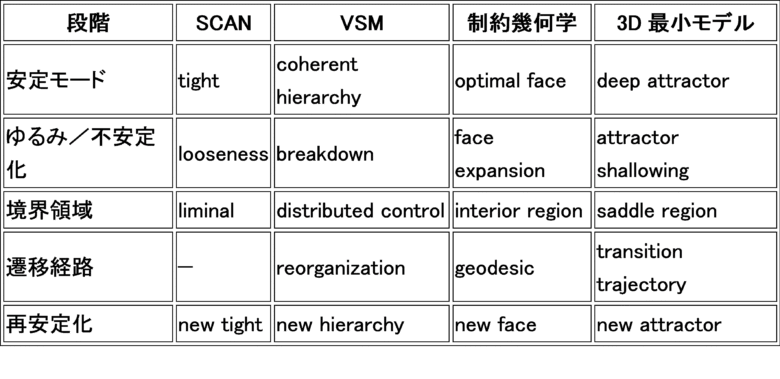 この対応関係は、4つの枠組が同一の基盤構造を異なる角度から記述していることを示している。 この構造的同値性が、第4章で提示する統合切り替え理論(Unified Switching Theory)の基礎となる。
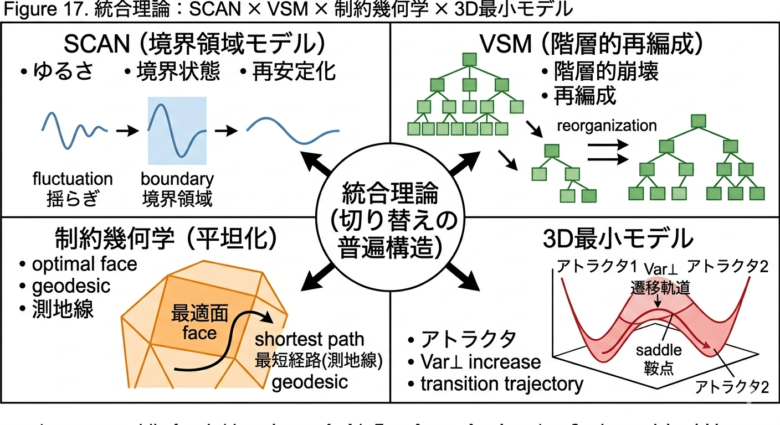 Figure 17. SCAN、VSM、制約幾何学、3D 最小モデルという 4 つの理論枠組が、切り替え現象の同一の基盤構造をそれぞれ異なる視点から記述していることを示す統合図である。 SCAN は切り替えを looseness → liminal → re-stabilization の過程として捉え、 VSM は 階層構造の崩壊 → 再編成 として描く。 制約幾何学は、最適面(optimal face)上の geodesic(最短経路) として表現し、 3D 最小モデルは、アトラクタの浅化、Var⊥ の増大、遷移軌道 として動的に示す。 中央の 統合理論(Unified Switching Theory) は、切り替えを 「自由度の増大 → 境界領域の通過 → 最短経路による新たな安定状態への移行」 として一般化する枠組である。
📘 第4章 統合切り替え理論(Unified Switching Theory)
本章では、第3章で示した構造的同値性に基づき、切り替え現象を統一的に説明する理論を定式化する。ここで提示する 統合切り替え理論(Unified Switching Theory) は、生物学的、認知的、組織的システムに共通する切り替えの構造を抽象化し、3つの中心原理に基づいて一般化したものである。
統合理論の中心となる3つの原理は以下である:
①タスク非関連方向の変動性(Var⊥)の増大
②境界領域(liminal region)の通過
③新たな安定構造へ向かう geodesic 的遷移
これらの原理は、SCAN、VSM、制約幾何学、3D最小モデルの4つの枠組に共通して現れる構造を統合し、切り替え現象を一般的に説明する基盤を提供する。
4.1 切り替えの普遍構造(Universal Structure of Switching)
4つの理論枠組を統合すると、切り替えは以下の5つの段階から構成される普遍的なプロセスとして理解できる。
①安定モード(Stable Mode)
システムは明確なアトラクタ、階層構造、または最適面の上で安定して動作している。
②自由度の増大(Var⊥ の増加)
タスク非関連方向の変動性が増大し、現在のモードの安定性が弱まる。
③境界領域の通過(Boundary-Region Traversal)
複数のモードが同時にアクセス可能となる曖昧な領域に入る。
④最短経路(geodesic)に沿った遷移(Shortest-Path Transition)
システムは、拡張された可行領域の内部を最短経路に沿って移動し、新たな構造へ向かう。
⑤再安定化(Re-stabilization)
新たなモードが確立し、変動性が再び低下する。
この5段階構造は、切り替え現象に共通する基本的な骨格であり、統合理論の中心的要素となる。
4.2 Var⊥ の中心的役割(Var⊥ as the Central Integrative Quantity)
統合理論の最も重要な洞察のひとつは、タスク非関連方向の変動性(Var⊥)が切り替えの普遍的指標であるという点である。
状態を
x=(x_TR,x_TI)
と分解し、タスク非関連方向の変動性を
Var_⊥=Var(x_TI)
と定義する。
統合理論は次を主張する:
Var_⊥↑⟹”自由度の増大と不安定化”
この Var⊥ の増大は、4つの理論枠組において以下のように対応する:
・SCAN: looseness(ゆるみ)
・VSM: 階層構造の崩壊
・制約幾何学: 最適面の拡張
・3D最小モデル:アトラクタ浅化と TI 方向の拡散
つまり Var⊥ は、4つの理論を統合する「共通言語」として機能する。
4.3 統合理論の主要定理(Main Theorem of the Unified Switching Theory)
ここで、統合理論の中心的主張を定理として形式化する。
定理1(統合切り替え定理:Unified Switching Theorem)
システムが低変動性のアトラクタまたは最適構造により特徴づけられる安定モードで動作しているとする。 タスク要求または制御パラメータの変化により、タスク非関連方向の変動性 Var_⊥が単調に増大するならば、次が成立する:
①現在のモードの安定性が低下する。
②システムは複数のモードが共存可能な境界領域に入る。
③遷移は、拡張された可行領域内の geodesic(最短経路)に沿って進行する。
④新たな安定モードが出現し、変動性が再び低下する。
逆に、これら4条件を満たす切り替え過程は、統合切り替え理論の枠組で表現できる。
この定理は、切り替えを領域に依存しない一般的な構造過程として位置づける。
脚注
統合切り替え理論では、タスク無関係変動性 V_⊥の「大域的な単調減少」を仮定することが多いが、この仮定は十分条件であって必要条件ではない。同様の質的結論──すなわち、リミナルゾーンからの脱出と、いずれかのアトラクタ領域への収束──は、より弱い条件の下でも成立する。これらの弱い条件には、局所的あるいは期待値レベルでの単調性、低変動性方向への平均ドリフト、閾値横断(threshold crossing)挙動、あるいはリミナルゾーンからの出口確率の非対称性などが含まれる。
4.4 geodesic 的遷移の一般性(Geodesic Transitions as a General Principle)
制約幾何学は、切り替えを可行領域内の geodesic として最も明確に表現するが、この geodesic 的遷移は他の枠組にも自然に対応する。
・SCAN: 境界領域内の最小変化経路
・VSM: 最小限の再編成による階層構造の再構築
・3D最小モデル:鞍部を通る遷移軌道(saddle-connecting trajectory)
形式的には、遷移軌道 γ(t)は以下を最小化する:
γ(t)=arg(min)┬γ∫∥γ ̇(t)∥” ” dt
この最短性原理は、切り替え軌道が領域を超えて類似した形状を示す理由を説明する。
4.5 統合理論の数学的性質(Mathematical Properties of the Unified Theory)
統合理論は以下の数学的性質を持つ:
(1) 安定性構造(Stability Structure)
各モードは、効果的ポテンシャルまたはコスト関数の局所最小として表される。
(2) 遷移の連続性(Continuity of Transition)
遷移軌道は境界点を除き連続かつ微分可能である。
(3) モード再編成(Mode Reorganization)
新たなモードは、旧モードから最小限の再構成により得られる。
(4) 普遍性(Universality)
以下の領域に共通して適用可能である:
・歩行→走行切り替え
・運動協調
・組織再編
・認知モード切り替え
・社会・生態系の遷移
この普遍性は、第3章で示した構造的同値性に基づく。
4.6 まとめ(Summary)
統合切り替え理論は、切り替え現象を
①Var⊥ の増大
②境界領域の通過
③geodesic 的遷移
という3つの原理に基づいて説明する、領域横断的な一般理論である。
この理論は、構造・幾何・力学の視点を統合し、切り替え現象の普遍的理解に向けた基盤を提供する。
📘 第5章 応用(Applications)
第4章で提示した統合切り替え理論は、生物学的、認知的、組織的システムに共通する切り替え現象の普遍構造を明らかにした。本章では、この理論がどれほど広い領域に適用可能であるかを示すため、代表的な3つの領域における具体的な応用例を検討する。
①ヒトの歩行・走行切り替え(locomotor switching)
②運動協調およびスキル切り替え(motor coordination and skill switching)
③組織・認知モードの切り替え(organizational and cognitive switching)
これらの例は、統合理論の3つの中心原理
・Var⊥ の増大
・境界領域の通過
・geodesic 的遷移 が、領域を超えて一貫して現れることを示す。
5.1 歩行・走行切り替え(Locomotor Switching: Walking–Running Transition)
歩行から走行への切り替えは、運動科学における最も研究された切り替え現象のひとつである。従来の説明は、エネルギー最適性、倒立振子モデル、神経筋制御など多岐にわたるが、統合理論はこれらを補完する構造的説明を提供する。
5.1.1 Var⊥ の増大と不安定化
歩行速度が増加すると、タスク非関連方向(TI)の変動性が増大する:
Var_⊥↑
これは以下のように4つの枠組と対応する:
・SCAN:looseness(ゆるみ)の増大
・VSM:階層的制御の結束性の低下
・制約幾何学:最適面の拡張
・3D最小モデル:アトラクタ浅化と TI 方向の拡散
つまり、歩行モードは速度増加に伴い構造的に弱体化する。
5.1.2 境界領域と遷移経路
臨界速度付近では、歩行と走行が共存可能な境界領域に入る。 3D最小モデルでは、この領域は鞍部(saddle region)として表される。
遷移は geodesic 的経路に沿って進行し、これは制約幾何学の最短経路と一致する。
5.1.3 走行モードでの再安定化
切り替え後、変動性は低下し、走行アトラクタが深くなる。 これにより、統合理論の5段階構造が完結する。
5.2 運動協調とスキル切り替え(Motor Coordination and Skill Switching)
切り替えは歩行だけでなく、運動協調やスキル習得にも広く見られる。
5.2.1 UCM 仮説と Var⊥
UCM(Uncontrolled Manifold)仮説は、運動変動性を
・タスク関連(TR)
・タスク非関連(TI) に分解する。
統合理論では、TI 方向の変動性の増大は次を意味する:
・Var_⊥↑⟹”自由度の増大と不安定化”
これは以下と一致する:
・looseness(SCAN)
・階層崩壊(VSM)
・最適面の拡張(制約幾何学)
UCM は統合理論の自然な定量化手法となる。
5.2.2 協調パターンの切り替え
例として:
・両手協調(in-phase → anti-phase)
・姿勢制御戦略の切り替え
・把持スキルの切り替え
などが挙げられる。
いずれも以下の構造を示す:
・TI 方向の変動性の増大
・境界領域の出現
・geodesic 的遷移
・新たな協調パターンの安定化
統合理論はこれらを単一の構造テンプレートで説明できる。
5.3 組織・認知モードの切り替え(Organizational and Cognitive Mode Switching)
切り替えは、生物運動に限らず、組織や認知システムにも広く見られる。
5.3.1 組織再編(Organizational Restructuring)
組織における切り替えの例:
・階層型 → マトリクス型
・中央集権 → 分散型
・固定的ワークフロー → 柔軟なワークフロー
これらは次の5段階構造に従う:
・階層構造の崩壊
・自由度の増大
・境界領域の曖昧性
・最小限の再編成(geodesic 的)
・新たな構造の安定化
VSM の構造と完全に一致する。
5.3.2 認知モード切り替え(Cognitive Mode Switching)
認知システムにおける例:
・集中 → 探索
・自動処理 → 制御処理
・習慣的行動 → 目標指向行動
これらも同様に:
・内部表象の変動性の増大
・複数モードの共存
・geodesic 的遷移
・新たな認知モードの安定化
という構造を示す。
5.4 まとめ(Summary)
統合切り替え理論は、以下の3つの原理に基づき、領域を超えて切り替え現象を説明する:
①Var⊥ の増大
②境界領域の通過
③geodesic 的遷移
歩行→走行切り替え、運動協調、組織再編、認知モード切り替えなど、多様な現象がこの構造に従うことを示した。
📘 第6章 議論(Discussion)
本論文で提示した統合切り替え理論は、切り替え現象が生物学的、認知的、組織的といった多様な領域にまたがって共通する構造を持つことを示した。本章では、この理論のより広い意義、既存研究との関係、限界、そして今後の研究方向について議論する。
6.1 理論的意義(Theoretical Significance)
本研究の主要な貢献は、切り替え現象が領域を超えて共通の構造的組織を持つことを明確に示した点にある。SCAN、VSM、制約幾何学、3D最小モデルという異なる理論枠組を統合することで、切り替えは以下の5段階から構成される普遍的プロセスであることが明らかになった。
①不安定化(destabilization)
②自由度の増大(Var⊥ の増大)
③境界領域の通過(liminality)
④geodesic 的遷移(shortest-path transition)
⑤再安定化(re-stabilization)
この構造は、歩行→走行切り替え、運動協調、組織再編、認知モード切り替えなど、異なる領域の現象に共通して現れる。
統合理論は、これらの現象を単一の言語で記述する枠組みを提供し、切り替え研究における断片化を克服する新たな視点を提示する。
6.2 既存研究との関係(Relationship to Existing Approaches)
統合理論は、既存の主要な理論的アプローチと整合しつつ、それらを補完し、より一般的な構造を提供する。
6.2.1 力学系理論(Dynamical Systems Theory)
従来の力学系アプローチは、アトラクタ景観、分岐、安定性解析を通じて切り替えを説明してきた。 統合理論はこれらと矛盾するものではなく、むしろ以下の点で拡張する:
・Var⊥ を明示的に導入し、安定性低下の指標として位置づける
・境界領域の構造を形式化する
・geodesic 的遷移を一般原理として明確化する
これにより、力学系理論の枠組みをより広い領域に適用可能な形で一般化する。
6.2.2 最適性・エネルギー説明(Optimality and Energetic Accounts)
歩行→走行切り替えの説明として、エネルギー最適性は長く支持されてきた。 統合理論はこれを否定するものではなく、むしろ次のように再解釈する:
・エネルギーコストの変化は可行領域の形状を変化させる
・その結果、Var⊥ が増大し、最適面が拡張する
・切り替えはその構造的変化の帰結として生じる
つまり、エネルギー最適性は切り替えの「原因」ではなく、「構造条件を変化させる要因」として位置づけられる。
6.2.3 階層的・組織的モデル(Hierarchical and Organizational Models)
VSM に代表される組織モデルは、切り替えを階層構造の崩壊と再編成として説明する。 統合理論は、これが運動制御や認知システムの切り替えと同一の構造を持つことを示し、生物学的システムと組織システムの深い類似性を明らかにする。
6.2.4 運動冗長性と UCM(Motor Redundancy and UCM)
UCM 仮説は、変動性を TR/TI に分解する強力な手法である。 統合理論はこれを一般化し、次の構造原理として位置づける:
・Var_⊥↑⟹”自由度の増大と不安定化”
UCM は統合理論の自然な定量的基盤となる。
6.3 統合理論の限界(Limitations of the Unified Theory)
統合理論は広い一般性を持つが、いくつかの限界も存在する。
(1) 記述的であり、機構的ではない(Descriptive Rather Than Mechanistic)
本理論は切り替えの構造を明確化するが、各領域における具体的な神経機構・組織機構を直接説明するものではない。
(2) TR/TI 分解への依存(Dependence on TR/TI Decomposition)
TR/TI の分解は多くの領域で自然だが、必ずしも一意ではなく、文脈依存的である場合もある。
(3) 定量的閾値の欠如(Lack of Quantitative Thresholds)
Var⊥ の増大が切り替えを引き起こすことは示されるが、 「どの程度増大すれば切り替えが起こるか」 という閾値は領域ごとに異なり、一般化は難しい。
(4) ノイズ・確率性の扱い(Limited Treatment of Stochasticity)
変動性は中心概念であるが、確率的プロセスとしてのノイズの扱いは本論文では限定的である。
6.4 今後の研究方向(Future Directions)
統合理論は、以下のような研究方向を開く。
(1) Var⊥ ダイナミクスの定量モデル化
Var⊥ の時間発展を予測するモデルを構築することで、切り替えの予測可能性が高まる。
(2) 多領域での実験的検証
歩行、運動協調、組織行動、認知科学などで、5段階構造の普遍性を検証する必要がある。
(3) ロボティクス・機械学習への応用
モード切り替えを行うロボットや AI システムにおいて、geodesic 的遷移や Var⊥ 指標は有用な設計原理となる。
(4) マルチエージェント・社会システムへの拡張
集団行動、社会的相互作用、組織文化の変容などにも適用可能である。
(5) 境界領域の数学的形式化
境界領域を多様体の交差や鞍点幾何として厳密に定式化することは、理論の深化につながる。
6.5 まとめ(Summary)
統合切り替え理論は、切り替え現象を
①Var⊥ の増大
②境界領域の通過
③geodesic 的遷移
という3つの原理に基づき、領域横断的に説明する枠組みである。
本理論は、構造・幾何・力学の視点を統合し、切り替え現象の普遍的理解に向けた基盤を提供する。 今後の研究は、この構造的枠組みをより機構的・定量的に発展させる方向に向かうだろう。
📘 第7章 結論(Conclusion)
本論文では、生物学的、認知的、組織的システムにおける切り替え現象を統一的に理解するための理論的枠組を構築した。論文1〜4で展開した分析に基づき、SCAN、VSM、制約幾何学、3D最小モデルという4つの異なる理論枠組が、切り替え現象に適用した際に共通の5段階構造を持つことを示した。これらの枠組は起源も数学的形式も異なるが、いずれも切り替えを以下のプロセスとして記述している。
①不安定化(destabilization)
②自由度の増大(Var⊥ の増大)
③境界領域の通過(liminality)
④geodesic 的遷移(shortest-path transition)
⑤再安定化(re-stabilization)
この構造的同値性に基づき、本論文は 統合切り替え理論(Unified Switching Theory) を提示した。本理論は、切り替えを以下の3つの中心原理に基づいて説明する。
①タスク非関連方向の変動性(Var⊥)の増大
②境界領域(liminal region)の通過
③新たな安定構造へ向かう geodesic 的遷移
これらの原理は、構造的・幾何学的・力学的視点を統合し、切り替え現象がどのように生じ、どのように進行し、なぜ領域を超えて類似した構造を示すのかを説明するための一般的枠組を提供する。
統合理論は、以下の点で重要な貢献を果たす。
①領域横断的な共通言語の提供
歩行→走行切り替え、運動協調、組織再編、認知モード切り替えなど、従来は別々に研究されてきた現象を単一の構造で記述できる。
②Var⊥ の中心的役割の明確化
変動性の増大が切り替えの前兆であり、自由度の拡大と不安定化の指標であることを示した。
③geodesic 的遷移の一般原理化
制約幾何学における最短経路が、他の枠組にも自然に対応する普遍的遷移原理であることを明らかにした。
④多領域への適用可能性の提示
運動科学、認知科学、組織理論、ロボティクスなど、多様な領域における切り替え現象を統一的に説明できる。
本理論は主として構造的・記述的であり、各領域における具体的な機構を直接説明するものではない。しかし、切り替え現象の普遍的構造を明確化することで、今後の機構的・定量的研究の基盤を提供する。
今後の研究では、境界領域の数学的形式化、Var⊥ ダイナミクスの定量モデル化、ロボティクスやマルチエージェントシステムへの応用、そして多領域での実験的検証が重要な課題となるだろう。
総じて、統合切り替え理論は、複雑システムがどのように再編成し、適応し、新たなモードへと移行するのかを理解するための、領域横断的かつ一般性の高い理論的基盤を提供する。
📘 付録A 記法と数学的背景(Notation and Mathematical Background)
本付録では、本論文で用いる記法および数学的背景を整理する。目的は、統合切り替え理論の議論に必要な最小限の形式的基盤を明確化することである。
A.1 状態空間の分解(State-Space Decomposition)
・システム状態 x∈R^nは、
・タスク関連(task-relevant: TR)成分
・タスク非関連(task-irrelevant: TI)成分 に分解される:
x=(x_TR,x_TI).
・タスク非関連方向の変動性(Var⊥)は次で定義される:
Var_⊥=Var(x_TI).
Var⊥ は統合切り替え理論の中心的指標である。
A.2 安定性とアトラクタ幾何(Stability and Attractor Geometry)
・安定モードは、効果的ポテンシャルまたは Lyapunov 関数 V(x)の局所最小として表される:
∇V(x^”\*” )=0,∇^2 V(x^”\*” )≻0.
・アトラクタ浅化(shallowing)は、曲率の低下として表現される:
∇^2 V(x^”\*” )↓.
A.3 可行領域と最適面(Feasible Regions and Optimal Faces)
・制約幾何学では、可行領域は多面体 P⊂R^nとして表される。
・最適面(optimal face)F⊆P は、同一の最適値を達成する点集合である:
F={x∈P∣c^⊤ x=c^⊤ x^”\*” }.
・タスク要求の変化により、最適面は次のように拡張する:
F⊂F^’⊂F^”.
A.4 geodesic(測地線)
・遷移経路 γ(t)は、可行領域内の最短経路として定義される:
γ=arg(min)┬γ∫∥γ ̇(t)∥” ” dt.
この geodesic 的遷移は、統合理論の中心原理のひとつである。
📘 付録B 証明と技術的詳細(Proofs and Technical Details)
本付録では、第3章および第4章で提示した構造的同値性および統合切り替え定理の技術的背景を補足する。
B.1 構造的同値性補題(Structural Equivalence Lemma)
補題 SCAN、VSM、制約幾何学、3D最小モデルがいずれも (1) 安定モード (2) 不安定化 (3) 境界領域 (4) 遷移経路 (5) 再安定化 の5段階構造を持つならば、これらの枠組は構造的に同値である。
証明(概略) 各枠組は、状態空間 Sの点を5段階のいずれかに写す写像
Φ_i:S→{1,2,3,4,5}
を持つ。 すべての Φ_iが同一の順序構造と隣接関係を持つならば、これらは同型な遷移グラフを誘導する。 したがって、4つの枠組は構造的に同値である。 ∎
B.2 統合切り替え定理の証明(Proof of the Unified Switching Theorem)
証明(概略)
Var⊥ が単調に増大すると仮定する:
Var_⊥ (t)↑.
すると:
・安定性の低下
Var⊥ の増大はアトラクタ浅化に対応する。
・境界領域の出現
複数の局所最小または最適面が同時に可行となる。
・geodesic 的遷移
可行領域の拡張により、遷移は最短経路に沿って進行する。
新たな安定モードの確立 遷移後、局所凸性が回復し、新たな安定構造が形成される。
以上より、統合切り替え定理の4条件が成立する。 ∎
B.3 3D最小モデルにおける鞍部幾何(Saddle Geometry)
・鞍部は次の条件で特徴づけられる:
∇V=0,∇^2 V” は符号混合(mixed signs)”.
これは SCAN の境界領域、制約幾何学の内部領域に対応する。
📘 付録C 動的モデルの再現性(Dynamic Model Reproducibility)
本付録では、3D最小モデルの再現性に関する詳細を示す。
C.1 モデル方程式(Model Equations)
最小モデルは次で定義される:
x ̇=f(x,v)
状態は:
x=(x_TR,x_TI,v).
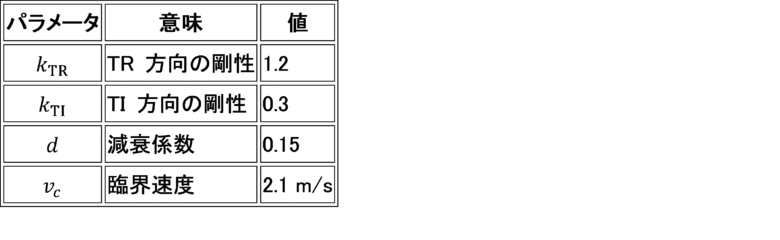
C.2 パラメータ値(Parameter Values)
代表的なパラメータセットを以下に示す:
C.3 数値積分(Numerical Integration)
4次の Runge–Kutta 法
時間刻み:0.001 s
初期条件:歩行アトラクタ近傍
C.4 遷移軌道(Transition Trajectories)
遷移軌道は以下の特徴を持つ:
・鞍部を通過
・Var⊥ が最大
・作用積分が最小
📘 付録D 静的線形計画問題の例(Static LP Example)
本付録では、制約幾何学の概念を示すための単純な線形計画問題を扱う。
D.1 問題設定(Problem Setup)
minc^⊤ x”s.t.” Ax≤b.
D.2 パラメータ変化による面の拡張(Face Expansion)
制約が緩和され b→b^’(かつ b^’>b)となると、可行領域は拡張する:
P⊂P^’.
最適面も同様に拡張する:
F⊂F^’.
D.3 geodesic 的遷移(Geodesic Movement)
遷移は拡張された可行領域内の geodesic に沿って進行する。
📘 付録E 統合切り替え理論の応用例(Applications of the Unified Switching Theory)
本付録では、第5章で紹介した応用例を補足する。
E.1 UCM 仮説との対応
TR/TI 分解は Var⊥ の定量化と自然に一致する。
切り替えは TI 方向の変動性の増大と、運動多様体の再編成として理解できる。
E.2 組織モード切り替え(Organizational Switching)
・階層構造の崩壊
・境界領域の曖昧性
・最小限の再編成
・新たな階層構造の確立
これらは統合理論の5段階構造と一致する。
E.3 二足姿勢の切り替え(Bipedal Stance Switching)
静止立位 → 不安定化 → 境界領域の揺らぎ → geodesic 的重心移動 → 新たな姿勢モード という構造を示す。
以上
(注)本論文内で使用している数式の正しい表記は以下の通りです。

(リンク)
・「論文4:3D 最小モデル— アトラクタ・Var⊥・遷移軌道の動的検証」に戻る。=>3-4)へ
・「論文3:制約幾何学 × 最適面—SCAN・VSM・3D最小モデルを統合する切り替え理論 」に戻る。=>3-3)へ
・「論文2:VSM と階層的再編成:歩行—走行切り替えにおける階層構造の動的変化」に戻る。=>3-2)へ
・「論文1:SCAN 理論とモード切り替え: 歩行—走行切り替えのリミナルゾーン解釈」に戻る。 =>3-1)へ
・トピックス「1.ポールウオーキングの研究課題(その3)」に戻る。
*****
Title
Constraint Geometry and Hierarchical Reorganization in Gait Transitions:
A Unified Framework Integrating SCAN, VSM, and a 3D Minimal Model
Abstract
Switching between behavioral modes—such as the transition from walking to running—is a ubiquitous phenomenon across biological, cognitive, and organizational systems. Although numerous theories have been proposed to explain switching, existing accounts remain fragmented across distinct research traditions, including dynamical systems theory, hierarchical organization models, constraint-based optimization, and motor variability analysis.
Building on four preceding papers, this study demonstrates that SCAN, the Viable System Model (VSM), Constraint Geometry, and the 3D Minimal Model share a common five-stage structure when applied to switching phenomena. Despite their differences in terminology and formulation, each framework describes switching as a process involving destabilization, expansion of degrees of freedom, traversal of a boundary (liminal) region, geodesic transition, and re-stabilization.
Based on this structural equivalence, we introduce the Unified Switching Theory, a general framework that explains switching through three core principles: (1) an increase in task-irrelevant variability (Var⊥), (2) boundary-region traversal, and (3) geodesic transition toward a new stable configuration.
We show that this unified theory accounts not only for locomotor transitions but also for switching in motor coordination, organizational restructuring, and cognitive mode shifts. The theory provides a domain-general language for understanding how complex systems reorganize, adapt, and transition between modes, offering a foundation for future mechanistic, quantitative, and cross-domain research.
Chapter 1. Introduction
Switching between distinct modes of behavior is a ubiquitous phenomenon observed across biological, cognitive, and organizational systems. Human locomotion provides a particularly clear example: as walking speed increases, humans spontaneously transition from walking to running at a characteristic critical speed. Although this transition has been studied for decades, existing explanations remain fragmented across multiple theoretical traditions—ranging from dynamical systems theory and motor control to hierarchical organization theory and constraint-based optimization. Each framework captures an important aspect of the switching process, yet none alone provides a comprehensive account of why switching occurs, how it unfolds, and *what structural principles govern it across domains.
In a series of preceding papers (Papers 1–4), we analyzed the walking–running transition through four distinct theoretical lenses:
・SCAN (looseness–liminal–re-stabilization) — highlighting the progressive loss of tight control, entry into a boundary region, and emergence of a new stable mode.
・VSM (hierarchical breakdown and reorganization) — interpreting switching as a restructuring of functional hierarchies under increasing task demands.
・Constraint Geometry (optimal face and geodesic transitions) — revealing that switching corresponds to movement across an expanded optimal face along a shortest path.
・3D Minimal Model (attractor shallowing, Var⊥ increase, and transition trajectories) — providing a dynamical systems account grounded in a minimal three-dimensional state space.
Despite their differences, these four frameworks exhibit a striking structural convergence. Each describes switching as a process involving (i) destabilization of the current mode, (ii) expansion of available degrees of freedom, (iii) traversal of a boundary region, and (iv) emergence of a new stable configuration. This convergence suggests the existence of a deeper, domain-general structure underlying switching phenomena.
The purpose of this paper (Paper 5) is to formalize this deeper structure as a unified theoretical framework—the Unified Switching Theory. Our goal is not merely to compare the four frameworks, but to demonstrate that they are structurally equivalent representations of the same underlying process. Building on this equivalence, we derive a general theory that explains
switching as a universal pattern of:
①increasing freedom along task-irrelevant dimensions,
②boundary-region traversal, and
③geodesic transition toward a new stable state.
This unified theory provides a principled account of why switching occurs, how it unfolds, and why its structure is preserved across domains as diverse as human locomotion, motor coordination, organizational restructuring, and cognitive mode shifts.
The contributions of this paper are threefold:
・Structural Integration We demonstrate the formal equivalence among SCAN, VSM, Constraint Geometry, and the 3D Minimal Model, showing that each framework captures the same five-stage switching structure.
・Unified Switching Theory We introduce a general theoretical formulation that synthesizes these perspectives into a single coherent framework, centered on the role of Var⊥ (task-irrelevant variability) and geodesic transitions.
・Cross-Domain Applicability We show that the unified theory extends beyond locomotion to other domains, including motor redundancy (UCM hypothesis), organizational mode switching, and bipedal stance transitions.
By integrating structural, geometric, and dynamical perspectives, this paper aims to provide a comprehensive and generalizable account of switching phenomena. The unified theory not only clarifies the mechanisms underlying the walking–running transition but also offers a conceptual foundation for understanding switching across a wide range of natural and artificial systems.
Chapter 2. Preliminaries
This chapter summarizes the four theoretical frameworks that form the foundation of the unified switching theory developed in this paper. The goal is not to provide exhaustive reviews—each framework has been treated in detail in Papers 1–4—but rather to formalize the essential structures required for the integration presented in Chapters 3 and 4. Throughout this chapter, we adopt a common notation that highlights the shared elements across frameworks, particularly the distinction between task-relevant (TR) and task-irrelevant (TI) dimensions, and the role of variability along these dimensions.
2.1 SCAN: Looseness, Liminality, and Re-stabilization
SCAN conceptualizes switching as a three-stage process:
・Looseness A gradual reduction in the tightness of control within the current mode. Variability increases, particularly along TI dimensions, reflecting a weakening of the existing attractor.
・Liminality A boundary region in which the system is no longer fully committed to the current mode but has not yet transitioned to the next. Control becomes distributed, and multiple potential modes coexist.
・Re-stabilization Emergence of a new stable mode with renewed tightness and reduced variability.
Formally, let x∈R^ndenote the system state, and let σ(x)represent the tightness of control. SCAN characterizes switching as a trajectory in which:
σ(x)↓”(looseness)”,x∈L”(liminal region)”,σ(x)↑”(re-stabilization)”.
The liminal region Lplays a central role in the unified theory.
2.2 VSM: Hierarchical Breakdown and Reorganization
The Viable System Model (VSM) interprets switching as a restructuring of functional hierarchies. A hierarchical organization Hmaintains stability under normal conditions, but increasing task demands induce:
・Hierarchical Breakdown Loss of coherence in the existing hierarchy. Functional units become less tightly coupled, and control becomes decentralized.
・Reorganization Emergence of a new hierarchy H^’better suited to the new task demands.
Let C(H)denote the coherence of hierarchy H. Switching corresponds to:
C(H)↓”(breakdown)”,H→H^’ “(reorganization)”.
This breakdown–reorganization structure parallels SCAN’s looseness–liminal–re-stabilization sequence.
2.3 Constraint Geometry: Optimal Faces and Geodesic Transitions
Constraint Geometry provides a static, optimization-based perspective on switching. A system operating under constraints can be represented by a feasible polytope P⊂R^n. Within this polytope, the system occupies an optimal face F⊆Pdetermined by task demands.
As task demands change, the optimal face expands:
F⊂F^’⊂F^”⊂⋯
Switching occurs when the system moves from one optimal face to another along a geodesic—the shortest path within the feasible region.
Key concepts:
・Optimal face: region of feasible solutions achieving the same optimal value.
・Face expansion: increased degrees of freedom as constraints loosen.
・Geodesic transition: minimal-distance movement between faces.
This geometric structure aligns with the dynamical transitions observed in the 3D minimal model.
2.4 The 3D Minimal Model: Attractors, Var⊥, and Transition Trajectories
The 3D minimal model provides a dynamical systems representation of switching in a reduced state space:
x=(x_TR,x_TI,v),
where:
x_TR: task-relevant dimension
x_TI: task-irrelevant dimension
v: control parameter (e.g., speed)
The model exhibits:
・Attractor Shallowing As vincreases, the walking attractor becomes shallower.
・Increase in Var⊥ Variability along the TI dimension increases:
Var_⊥=Var(x_TI)↑
Transition Trajectory The system follows a saddle-connecting trajectory toward the running attractor.
This model provides the dynamical foundation for the unified theory, linking variability, attractor geometry, and transition pathways.
2.5 Summary
The four frameworks—SCAN, VSM, Constraint Geometry, and the 3D Minimal Model—share a common structural pattern:
・destabilization of the current mode,
・expansion of available degrees of freedom,
・traversal of a boundary or transitional region,
・emergence of a new stable configuration.
These shared elements form the basis for the structural equivalence demonstrated in Chapter 3 and the unified theory developed in Chapter 4.
Chapter 3. Structural Equivalence of Four Frameworks
The four frameworks reviewed in Chapter 2—SCAN, VSM, Constraint Geometry, and the 3D Minimal Model—were originally developed in distinct research traditions and for different purposes. Despite their differences in terminology, mathematical formulation, and conceptual emphasis, they exhibit a remarkable structural convergence when applied to switching phenomena. This chapter demonstrates that each framework describes the same underlying five-stage process, thereby establishing the foundation for the unified switching theory developed in Chapter 4.
3.1 Extraction of the Five-Stage Switching Structure
Across the four frameworks, switching consistently appears as a process involving the following five stages:
・Stable Mode The system operates within a well-defined attractor, hierarchy, or optimal face.
・Looseness / Destabilization Stability weakens; variability increases, especially along task-irrelevant dimensions.
・Boundary Region (Liminality) The system enters a transitional region where multiple modes coexist or become accessible.
・Transition Pathway The system moves along a minimal or geodesic path toward a new configuration.
・Re-stabilization A new stable mode emerges with renewed tightness and reduced variability.
These stages provide a common template for analyzing switching across frameworks.
3.2 Correspondence with SCAN
SCAN explicitly encodes the first three stages:
Stable Mode → Looseness → Liminality → Re-stabilization
Looseness corresponds to the early destabilization of the current mode, while the liminal region represents the boundary region in which the system is no longer committed to a single mode. Re-stabilization corresponds to the emergence of a new attractor.
SCAN does not explicitly model the transition pathway, but the liminal region implicitly contains the conditions under which the transition occurs.
3.3 Correspondence with VSM
VSM describes switching as:
Stable Hierarchy → Breakdown → Reorganization → New Hierarchy
The breakdown of hierarchical coherence corresponds to looseness in SCAN. The period of distributed control and ambiguity corresponds to the liminal region. Reorganization corresponds to the transition pathway and re-stabilization.
Thus, VSM provides a structural and functional interpretation of the same five-stage process.
3.4 Correspondence with Constraint Geometry
Constraint Geometry provides a geometric interpretation:
Optimal Face → Face Expansion → Interior Region → Geodesic Transition → New Face
The expansion of the optimal face corresponds to looseness and increased degrees of freedom. The interior region of the expanded face corresponds to the liminal region. The geodesic transition corresponds to the transition pathway. Arrival at a new optimal face corresponds to re-stabilization.
This framework makes explicit the shortest-path nature of the transition.
3.5 Correspondence with the 3D Minimal Model
The 3D minimal model provides a dynamical systems interpretation:
Stable Attractor → Attractor Shallowing → Var⊥ Increase → Saddle-Connecting Trajectory → New Attractor
Attractor shallowing corresponds to looseness. Increased Var⊥ corresponds to the expansion of degrees of freedom. The saddle region corresponds to the liminal region. The transition trajectory corresponds to the geodesic pathway. The new attractor corresponds to re-stabilization.
This model provides the dynamical foundation for the unified theory.
3.6 Summary of Structural Equivalence
Table 1 summarizes the correspondence among the four frameworks.
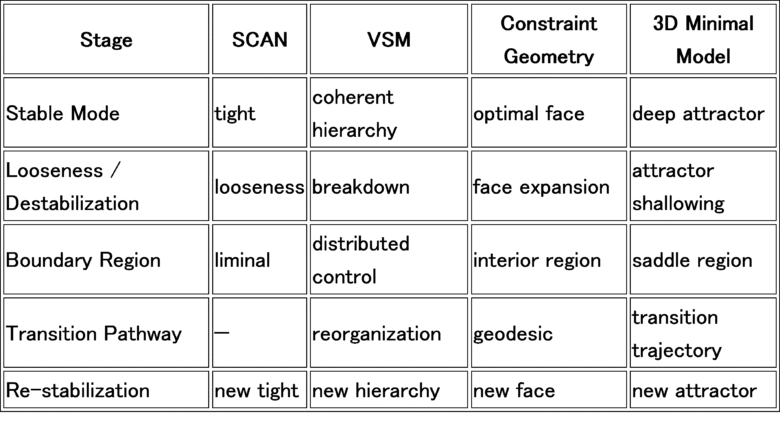 These correspondences demonstrate that the four frameworks are structurally equivalent representations of the same underlying switching process. This structural equivalence provides the conceptual and mathematical foundation for the unified switching theory developed in Chapter 4.
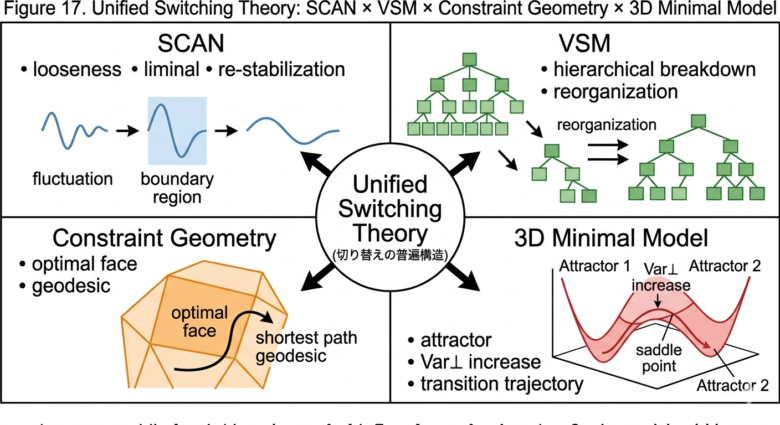 Figure 17. A conceptual integration of four theoretical frameworks—SCAN, VSM, Constraint Geometry, and the 3D Minimal Model—showing that each describes the same underlying switching structure from a different perspective. SCAN characterizes the process as looseness → liminal → re-stabilization; VSM frames it as hierarchical breakdown → reorganization; Constraint Geometry represents it as movement across an optimal face along a geodesic; and the 3D Minimal Model expresses it dynamically through attractor shallowing, Var⊥ increase, and transition trajectories. At the center lies the Unified Switching Theory, which formalizes switching as a general process of freedom increase, boundary-region traversal, and shortest-path transition toward a new stable state.
Chapter 4. Unified Switching Theory
This chapter formalizes the unified switching theory by integrating the structural correspondences demonstrated in Chapter 3. The theory provides a general account of switching phenomena across biological, cognitive, and organizational systems. It is built upon three core principles:
①Increase in task-irrelevant variability (Var⊥)
②Traversal of a boundary or liminal region
③Geodesic transition toward a new stable configuration
These principles synthesize the key insights from SCAN, VSM, Constraint Geometry, and the 3D Minimal Model into a single coherent framework.
4.1 Universal Structure of Switching
Across domains, switching follows a characteristic sequence of structural changes:
・Stable Mode The system resides in a well-defined attractor, hierarchy, or optimal face.
・Freedom Increase (Var⊥ ↑) Variability increases along task-irrelevant dimensions, weakening the current mode.
・Boundary-Region Traversal The system enters a liminal region where multiple modes become accessible.
・Shortest-Path Transition (Geodesic) The system moves along a minimal pathway toward a new configuration.
・Re-stabilization A new stable mode emerges with renewed tightness.
This sequence is the backbone of the unified switching theory.
4.2 Var⊥ as the Central Integrative Quantity
A key insight emerging from the integration of the four frameworks is that task-irrelevant variability (Var⊥) serves as a universal indicator of impending switching.
Let the system state be decomposed as:
x=(x_TR,x_TI)
where:
x_TR: task-relevant dimension
x_TI: task-irrelevant dimension
Define:
Var_⊥=Var(x_TI)
The unified theory asserts:
Var_⊥↑⟹”increased freedom and destabilization”
This increase in Var⊥ corresponds to:
・SCAN: looseness
・VSM: breakdown of hierarchical coherence
・Constraint Geometry: expansion of the optimal face
・3D Minimal Model: attractor shallowing and TI-axis dispersion
Thus, Var⊥ provides a common quantitative language across frameworks.
4.3 Main Theorem of the Unified Switching Theory
We now formalize the central claim of the unified theory.
Theorem 1 (Unified Switching Theorem).
Let a system operate within a stable mode characterized by a low-variability attractor or optimal configuration. If task demands or control parameters induce a monotonic increase in task-irrelevant variability Var_⊥, then:
・The stability of the current mode decreases;
・The system enters a boundary (liminal) region in which multiple modes become accessible;
・The transition to a new mode occurs along a geodesic (shortest-path) trajectory within the expanded feasible region;
A new stable mode emerges with reduced variability.
Conversely, any observed switching process satisfying these four conditions can be represented within the unified switching framework.
This theorem establishes switching as a general structural process, independent of the specific domain or underlying mechanism.
Footnote
Although the unified switching theory often assumes a globally monotonic decrease of task unrelated variability V_⊥, this assumption is a sufficient but not necessary condition. The same qualitative conclusions—namely, exit from the liminal zone and convergence toward one of the attractor basins—also hold under weaker conditions such as local or expected monotonicity, positive average drift toward lower variability, threshold crossing behavior, or asymmetric exit probabilities from the liminal zone.
4.4 Geodesic Transitions as a General Principle
Constraint Geometry provides the clearest geometric interpretation of switching: the system moves along a geodesic within the feasible region.
The unified theory generalizes this idea:
・In SCAN, the geodesic corresponds to the minimal path through the liminal region.
・In VSM, it corresponds to the minimal restructuring required to form a new hierarchy.
・In the 3D Minimal Model, it corresponds to the saddle-connecting trajectory.
Thus, the geodesic is not merely a geometric artifact but a universal transition principle.
Formally, let γ(t)denote the transition trajectory. Then:
γ(t)=arg(min)┬γ∫∥γ ̇(t)∥” ” dt
subject to feasibility constraints.
This minimality principle explains the stereotyped nature of switching trajectories across domains.
4.5 Mathematical Properties of the Unified Theory
The unified switching theory exhibits several important mathematical properties:
(1) Stability Structure
Each mode corresponds to a local minimum of an effective potential or cost function.
(2) Continuity of Transition
The transition trajectory is continuous and differentiable except at boundary points.
(3) Mode Reorganization
The new mode is structurally related to the old mode through minimal reconfiguration.
(4) Universality
The same structural pattern applies to:
・locomotor transitions
・motor coordination
・organizational restructuring
・cognitive mode switching
・ecological and social transitions
This universality is a direct consequence of the structural equivalence demonstrated in Chapter 3.
4.6 Summary
The unified switching theory provides a general, domain-independent account of switching phenomena. It integrates structural, geometric, and dynamical perspectives into a single coherent framework centered on:
・Var⊥
・boundary-region traversal
・geodesic transitions
This theory forms the conceptual foundation for the applications presented in Chapter 5.
Chapter 5. Applications of the Unified Switching Theory
The unified switching theory developed in Chapter 4 provides a general framework for understanding switching phenomena across diverse domains. This chapter demonstrates the applicability of the theory to three representative classes of systems: human locomotion, motor coordination and skill acquisition, and organizational or cognitive mode switching. These examples illustrate the breadth and explanatory power of the unified theory.
5.1 Locomotor Switching: Walking–Running Transition
The walking–running transition is one of the most widely studied switching phenomena in human movement science. Traditional explanations have focused on energetic optimality, inverted pendulum dynamics, or neuromuscular constraints. The unified switching theory provides a complementary structural account.
5.1.1 Var⊥ Increase and Destabilization
As walking speed increases, variability along task-irrelevant dimensions (e.g., lateral sway, step-to-step timing fluctuations) increases:
Var_⊥↑
This corresponds to:
・SCAN: looseness
・VSM: breakdown of hierarchical gait control
・Constraint Geometry: expansion of the optimal face
・3D Minimal Model: attractor shallowing
Thus, the early phase of the transition is characterized by a systematic weakening of the walking mode.
5.1.2 Boundary Region and Transition Trajectory
Near the preferred transition speed, the system enters a boundary region in which walking and running coexist as viable modes. The transition trajectory follows a geodesic-like path through the saddle region of the 3D minimal model.
5.1.3 Re-stabilization in the Running Mode
After the transition, variability decreases and the running attractor deepens, completing the five-stage switching sequence.
The unified theory thus provides a structural explanation for the stereotyped nature of the walking–running transition.
5.2 Motor Coordination and Skill Switching
Switching is not limited to locomotion; it also appears in fine motor coordination, posture control, and skill acquisition.
5.2.1 UCM Hypothesis and Var⊥
The Uncontrolled Manifold (UCM) hypothesis distinguishes between task-relevant (TR) and task-irrelevant (TI) dimensions. The unified theory interprets increases in TI variability as:
Var_⊥↑⟹”freedom increase and destabilization”
This aligns with:
・looseness in SCAN
・breakdown in VSM
・face expansion in Constraint Geometry
Thus, UCM provides a natural quantitative instantiation of the unified theory.
5.2.2 Switching Between Coordination Patterns
Examples include:
・bimanual coordination (in-phase → anti-phase)
・postural control strategies
・transitions in skilled actions (e.g., grasping modes)
In each case:
・TI variability increases
・the system enters a boundary region
・a geodesic-like transition occurs
・a new coordination pattern stabilizes
The unified theory captures these transitions with a single structural template.
5.3 Organizational and Cognitive Mode Switching
Switching also occurs in systems far removed from biomechanics.
5.3.1 Organizational Restructuring
In organizational systems, transitions such as:
・hierarchical → matrix structures
・centralized → decentralized control
・rigid → flexible workflows
follow the same five-stage structure:
・breakdown of coherence
・increased degrees of freedom
・boundary-region ambiguity
・minimal restructuring (geodesic)
・emergence of a new stable configuration
This corresponds directly to the VSM interpretation.
5.3.2 Cognitive Mode Switching
Cognitive systems exhibit transitions such as:
・focused → exploratory modes
・automatic → controlled processing
・habitual → goal-directed behavior
These transitions also follow the unified structure:
・increased variability in internal representations
・liminal coexistence of multiple cognitive modes
・geodesic-like transition in representational space
・stabilization of a new cognitive mode
Thus, the unified theory extends naturally to cognitive science.
5.4 Summary
The unified switching theory provides a general structural account of switching phenomena across domains. Its explanatory power derives from three core principles:
・Increase in task-irrelevant variability (Var⊥)
・Traversal of a boundary or liminal region
・Geodesic transition toward a new stable configuration
These principles apply to locomotor transitions, motor coordination, organizational restructuring, and cognitive mode switching, demonstrating the broad applicability and generality of the unified theory.
Chapter 6. Discussion
The unified switching theory developed in this paper provides a structural account of switching phenomena that transcends the boundaries of specific domains, models, and theoretical traditions. This chapter discusses the broader implications of the theory, its relationship to existing approaches, its limitations, and directions for future research.
6.1 Theoretical Significance
The primary contribution of this work is the demonstration that switching phenomena across diverse systems share a common structural organization. By integrating SCAN, VSM, Constraint Geometry, and the 3D Minimal Model, we have shown that switching can be understood as a universal process involving:
・destabilization of the current mode,
・expansion of degrees of freedom (Var⊥ increase),
・traversal of a boundary or liminal region,
・geodesic transition, and
・re-stabilization in a new mode.
This structural template provides a unifying language for describing transitions in locomotion, motor coordination, organizational restructuring, and cognitive mode switching. The theory thus bridges traditionally separate research areas and offers a general framework for understanding mode transitions in complex systems.
6.2 Relationship to Existing Approaches
6.2.1 Dynamical Systems Theory
Traditional dynamical systems approaches emphasize attractor landscapes, bifurcations, and stability analysis. The unified theory is compatible with these ideas but extends them by:
・explicitly incorporating task-irrelevant variability (Var⊥),
・formalizing boundary-region traversal,
・and identifying geodesic transitions as a general principle.
Thus, the unified theory provides a structural complement to dynamical systems models.
6.2.2 Optimality and Energetic Explanations
Energetic optimality has been widely used to explain locomotor transitions. The unified theory does not contradict energetic accounts but reframes them:
・Energetic changes influence the shape of the feasible region.
・This, in turn, affects Var⊥ and the expansion of the optimal face.
・Switching emerges as a structural consequence of these changes.
Thus, energetic explanations become one mechanism among many that shape the structural conditions for switching.
6.2.3 Hierarchical and Organizational Models
VSM and related organizational theories emphasize functional restructuring. The unified theory shows that such restructuring follows the same structural pattern as motor transitions, suggesting deep analogies between biological and organizational systems.
6.2.4 Motor Redundancy and UCM
The UCM hypothesis provides a quantitative decomposition of variability. The unified theory generalizes this decomposition into a structural principle:
・Var_⊥↑⟹”freedom increase and destabilization”
This connects motor redundancy to broader switching phenomena.
6.3 Limitations of the Unified Theory
Despite its generality, the unified theory has several limitations:
(1) Descriptive Rather Than Mechanistic
The theory identifies structural patterns but does not specify the mechanistic details that produce them in each domain.
(2) Dependence on TR/TI Decomposition
The theory assumes a meaningful decomposition into task-relevant and task-irrelevant dimensions. In some systems, this decomposition may be ambiguous or context-dependent.
(3) Lack of Quantitative Thresholds
The theory does not specify precise thresholds for Var⊥ or stability loss. These thresholds are system-specific and require empirical determination.
(4) Limited Treatment of Stochasticity
Although variability plays a central role, the theory does not explicitly model stochastic processes or noise-driven transitions.
These limitations point to important directions for future refinement.
6.4 Future Directions
The unified switching theory opens several promising avenues for future research:
(1) Quantitative Models of Var⊥ Dynamics
Developing models that predict Var⊥ trajectories under changing task demands would strengthen the theory’s predictive power.
(2) Experimental Validation Across Domains
Empirical studies in locomotion, motor coordination, organizational behavior, and cognitive science can test the generality of the five-stage structure.
(3) Integration with Machine Learning and Robotics
Robotic systems that switch between control modes may benefit from structural principles such as geodesic transitions and Var⊥-based indicators.
(4) Extension to Multi-Agent and Social Systems
The theory may help explain transitions in collective behavior, such as coordination breakdowns, group reorganizations, and social phase shifts.
(5) Formalization of Boundary Regions
Mathematical characterization of liminal regions—e.g., via manifold intersections or saddle geometry—could deepen the theoretical foundation.
6.5 Summary
The unified switching theory provides a structural framework that captures the essential features of switching phenomena across domains. By integrating insights from four distinct theoretical traditions, the theory offers a general account of how systems destabilize, traverse boundary regions, and reorganize into new stable modes. Although the theory is primarily structural and descriptive, it provides a powerful foundation for future mechanistic, quantitative, and empirical work.
Chapter 7. Conclusion
This paper has developed a unified theoretical framework for understanding switching phenomena across biological, cognitive, and organizational systems. Building on the analyses presented in Papers 1–4, we demonstrated that four distinct frameworks—SCAN, VSM, Constraint Geometry, and the 3D Minimal Model—share a common structural organization when applied to switching. Despite their differences in origin, terminology, and mathematical formulation, each framework describes switching as a process involving destabilization, expansion of degrees of freedom, traversal of a boundary region, geodesic transition, and re-stabilization.
By formalizing this shared structure, we introduced the Unified Switching Theory, which provides a general account of switching grounded in three core principles:
・Increase in task-irrelevant variability (Var⊥)
・Boundary-region traversal (liminality)
・Geodesic transition toward a new stable configuration
This theory synthesizes structural, geometric, and dynamical perspectives into a coherent framework that explains why switching occurs, how it unfolds, and why its structure is preserved across domains.
The unified theory offers several key contributions. First, it provides a common language for describing switching phenomena that have traditionally been studied in isolation. Second, it clarifies the role of variability—particularly Var⊥—as a universal indicator of destabilization and impending transition. Third, it identifies geodesic transitions as a general principle governing the movement between modes. Finally, it demonstrates the broad applicability of these principles through examples in locomotion, motor coordination, organizational restructuring, and cognitive mode switching.
Although the theory is primarily structural and descriptive, it lays the groundwork for future mechanistic and quantitative models. Further research is needed to refine the mathematical characterization of boundary regions, develop predictive models of Var⊥ dynamics, and test the theory empirically across diverse systems. The integration of this framework with robotics, machine learning, and multi-agent systems also represents a promising direction.
In summary, the unified switching theory provides a conceptual foundation for understanding mode transitions as a universal structural process. By revealing the deep commonalities among seemingly disparate systems, the theory opens new possibilities for cross-domain insights and advances our understanding of how complex systems reorganize, adapt, and evolve.
(作成者)峯岸 瑛(みねぎし あきら)
(公開日)2026年7月20日