Article 2:
Variability, Stability, and the SCAN Framework
How perception, cognition, and action shape human gait
1. Introduction: Why Variability Matters
When people think about walking, they often imagine a steady, repetitive pattern. But real human gait is never perfectly regular. Every step contains small fluctuations—tiny adjustments in timing, force, and posture.
These fluctuations are not errors. They are the engine of adaptability.
To understand how humans maintain stability, respond to uncertainty, and switch between movement modes, we must understand variability—and how the brain interprets it.
This is where the SCAN framework becomes essential.
2. The SCAN Framework: A Bridge Between Body and Mind
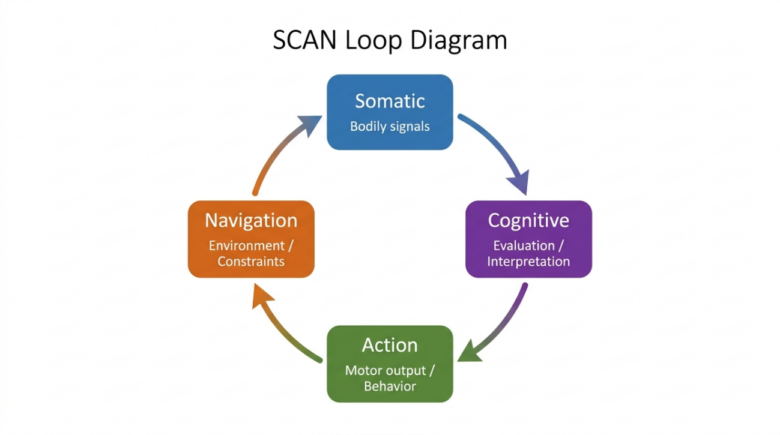 SCAN stands for Somato Cognitive Action Network. It describes how sensory information, cognitive evaluation, and motor action form a continuous loop.
The SCAN loop consists of:
• Somatic signals (proprioception, pressure, joint angles, vestibular cues)
• Cognitive interpretation (effort, balance confidence, perceived stability)
• Action selection (adjusting step length, rhythm, posture, or switching gait)
This loop runs continuously, shaping every step we take.
3. Stability as a Perceptual–Cognitive Experience
Stability is not only a biomechanical property. It is also a perceptual experience.
Two people walking with identical mechanics may feel very different levels of stability because:
• their sensory sensitivity differs
• their cognitive thresholds for “instability” differ
• their past experiences influence interpretation
• their attention shifts moment to moment
SCAN explains why stability is both physical and psychological.
4. Variability as Information, Not Noise
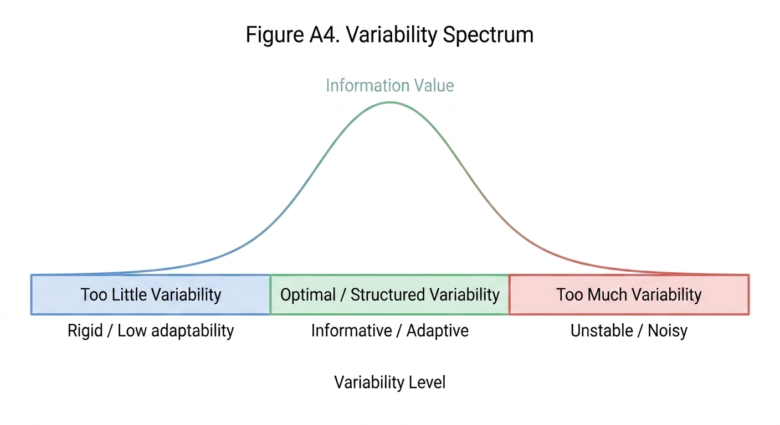 In the SCAN framework, variability is information.
It tells the system:
• how stable the current gait pattern is
• whether adjustments are needed
• whether an alternative pattern (like running) might be better
• whether environmental conditions are changing
Healthy gait shows structured variability—neither too rigid nor too chaotic.
This “sweet spot” allows the system to adapt without losing control.
5. When Variability Increases: Approaching the Liminal Zone
As constraints change—speed increases, terrain shifts, fatigue builds—variability begins to rise.
This increase is not random. It is the system’s way of exploring.
SCAN interprets rising variability as:
• reduced confidence in the current attractor
• increased need for sensory sampling
• preparation for a possible transition
This is how the system enters the liminal zone, where switching becomes possible.
6. How Standard Pole Walking Modulates the SCAN Loop
Standard Pole Walking (Japanese Method) interacts with the SCAN loop in several ways:
• Somatic level Poles provide additional sensory cues and stabilize the COM.
• Cognitive level Reduced fear of falling and clearer perception of stability.
• Action level More consistent rhythm, reduced compensatory movements.
The result is a cleaner SCAN loop with less noise and more reliable feedback.
This explains why SPW reduces unnecessary variability and delays premature switching.
7. Conclusion: SCAN as a Key to Understanding Human Movement
Variability, stability, and switching are not separate phenomena. They are expressions of a single integrated system—the SCAN loop.
By understanding this loop, we gain insight into:
• how humans maintain balance
• how transitions emerge
• how tools like poles reorganize movement
• how perception and action shape each other
This framework forms the foundation for the rest of the series.
*** Link ***
→ Opening Article
→ Article 1