🌍 Opening Article – The Story of Switching
How human gait reveals a unified system of stability, variability, and transitions
1. Why Gait Is More Than Walking
Human gait is often described as a simple, repetitive movement. But when we look closely, walking is not a fixed pattern—it is a dynamic system that constantly reorganizes itself in response to constraints, variability, and environmental demands.
Every step is a negotiation between stability and exploration, efficiency and adaptability. And at the heart of this negotiation lies a remarkable phenomenon:
switching—the spontaneous transition between walking and running.
This series begins with a simple question:
Why do humans switch from walking to running, and what does this reveal about how movement systems work?
The answer leads us into a unified framework that connects biomechanics, perception, cognition, and system dynamics.
2. Switching as a Window into Human Movement
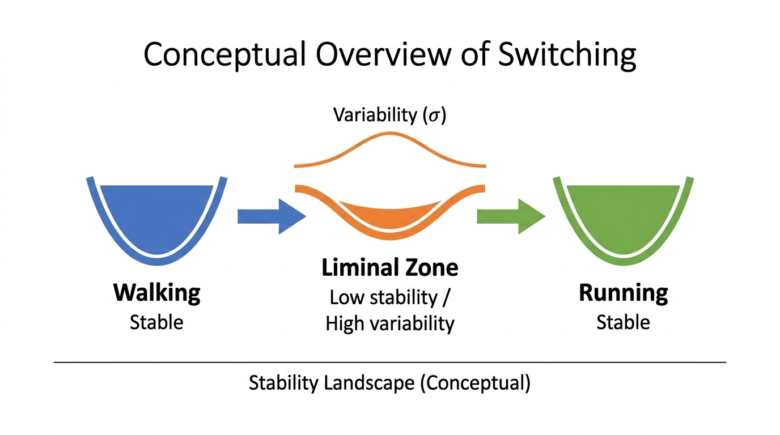 Switching is not merely a change in speed. It is a system level reorganization—a shift from one stable mode of movement to another.
When walking becomes inefficient or unstable under certain constraints, the system reorganizes into a new attractor: running.
This transition reveals:
• how the body manages variability
• how constraints shape movement
• how perception and cognition influence action
• how stability landscapes shift in real time
Switching is therefore a powerful lens for understanding the deeper logic of human movement.
3. The Role of Variability and Liminal Zones
Healthy gait is not rigid. It contains structured variability—micro fluctuations that allow the system to adapt.
When variability increases beyond a certain threshold, the system enters a liminal zone: a boundary region where walking becomes unstable and running becomes increasingly attractive.
In this zone:
• step timing fluctuates
• the center of mass wavers
• metabolic cost rises
• sensory cues become ambiguous
The system explores alternatives, and switching becomes possible.
4. A Unified Framework: SCAN, Constraints, and Hierarchy
To understand switching, we need a framework that integrates:
• SCAN (Somato Cognitive Action Network)
How perception, cognition, and action interact.
• Constraint based optimization
How movement emerges from real time problem solving.
• Hierarchical organization
How low level biomechanics and high level strategies coordinate.
Together, these models reveal gait as a multi layered, self organizing system.
5. Why Standard Pole Walking Matters
Standard Pole Walking (Japanese Method) provides a unique practical example of this unified framework.
By adding vertical poles, we can observe how:
• stability is reorganized
• variability is shaped
• switching behavior changes
• cognitive load decreases
• new optimal solutions emerge
SPW is not just a technique—it is a designed movement system that makes the hidden structure of gait visible.
6. What This Series Will Explore
Throughout this series, we will examine:
• how walking and running emerge as stable attractors
• how variability supports adaptability
• how constraints shape movement patterns
• how switching reflects system level reorganization
• how Standard Pole Walking embodies these principles
Each article builds on the previous one, gradually revealing how human gait can be understood as a unified, dynamic system.
7. Invitation to the Reader
This series is written for researchers, clinicians, practitioners, and curious readers who want to understand human movement not as a collection of parts, but as a coherent whole.
If you have ever wondered why walking feels effortless one moment and unstable the next, or why switching happens when it does, or how simple tools like poles can reorganize the entire movement system—
you are in the right place.
Let’s begin the story of switching.
*** Link ***
→ Article 1
→ Article 2
→ Article 3
→ Article 4
→ Article 5