Article 4
Hierarchy and Reorganization in Human Gait
How multi layer control shapes transitions and stability
1. Introduction: Movement Happens in Layers
Human movement is not controlled by a single mechanism. It emerges from multiple layers of the nervous system and body working together.
These layers range from:
• reflexive responses
• rhythmic coordination
• balance strategies
• cognitive evaluation
• intentional planning
Walking is therefore not a single process—it is a hierarchical system.
Understanding this hierarchy is essential for explaining why gait is stable, why it adapts, and why transitions such as switching occur.
2. The Three Layers of Gait Control
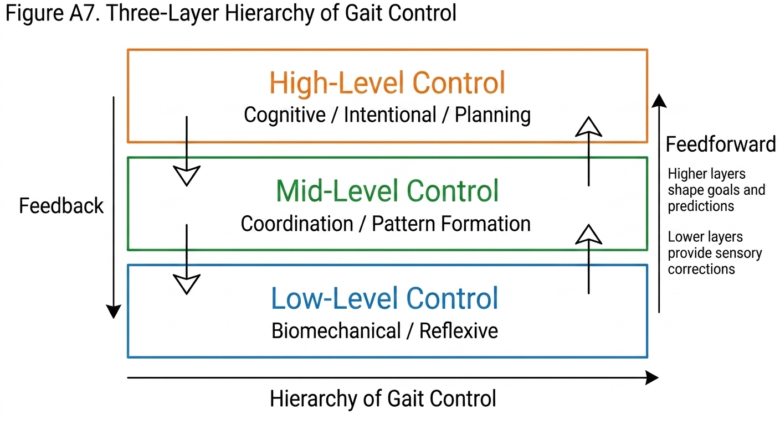 Although the real system is complex, we can understand gait through three functional layers:
1. Low level (Biomechanical Layer)
• joint mechanics
• muscle properties
• ground reaction forces
• passive dynamics
This layer provides the physical foundation.
2. Mid level (Coordination Layer)
• left–right alternation
• timing and rhythm
• pattern generation
This layer organizes movement into coherent patterns.
3. High level (Cognitive–Perceptual Layer)
• balance strategies
• effort evaluation
• attention and intention
• switching decisions
This layer interprets the situation and sets goals.
These layers form a nested hierarchy, where higher levels guide lower levels, and lower levels provide feedback upward.
3. Stability Emerges from Hierarchical Cooperation
Stability is not produced by any single layer. It emerges from cooperation across layers.
For example:
• low level mechanics stabilize the center of mass
• mid level coordination maintains rhythm
• high level perception monitors balance
If one layer becomes stressed—fatigue, noise, terrain changes—other layers compensate.
This is why humans can walk on uneven ground, recover from slips, or adjust to new environments.
4. Reorganization: When the Hierarchy Shifts
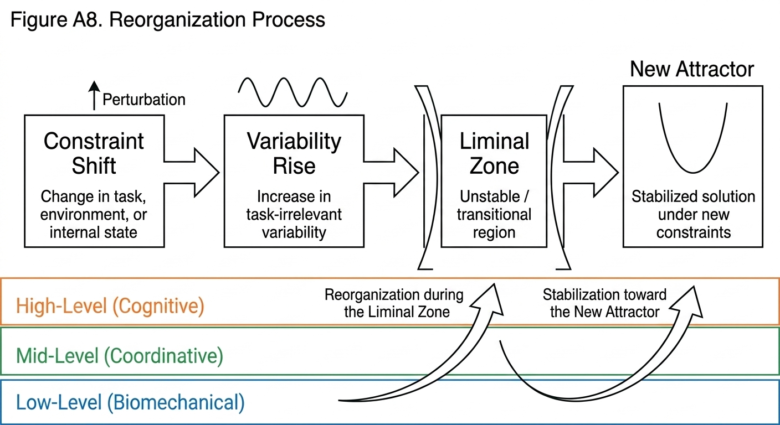 When constraints change, the hierarchy must reorganize.
Examples:
• When speed increases, mid level coordination becomes unstable.
• High level perception detects rising effort and variability.
• Low level mechanics become inefficient for walking.
The system then transitions to a new attractor—running.
This reorganization is not a failure. It is the system’s way of maintaining efficiency and stability.
5. The Role of Variability in Reorganization
Variability acts as the “messenger” between layers.
• Low level variability signals mechanical instability.
• Mid level variability signals rhythm breakdown.
• High level variability signals perceptual uncertainty.
When variability increases across layers, the system enters the liminal zone, where reorganization becomes likely.
This is why variability is essential—not noise, but information.
6. How Standard Pole Walking Influences the Hierarchy
Standard Pole Walking (Japanese Method) affects all three layers simultaneously.
Low level effects
• stabilizes the center of mass
• reduces joint loading
• provides additional support points
Mid level effects
• organizes rhythm
• reduces unnecessary variability
• supports consistent alternation
High level effects
• reduces cognitive load
• increases balance confidence
• clarifies sensory cues
Because SPW influences the entire hierarchy, it reshapes the conditions for reorganization—delaying instability and making transitions safer and more predictable.
7. Conclusion: Hierarchy as the Hidden Architecture of Gait
Human gait is a layered, adaptive system. Transitions such as switching occur when the hierarchy reorganizes in response to changing constraints.
By understanding this architecture, we can see:
• why stability emerges
• why variability matters
• how transitions occur
• how tools like poles reorganize movement
This prepares us for the final article, where we explore Standard Pole Walking as a designed movement system that leverages these principles.
*** Link ***
→ Opening Article
→ Article 1
→ Article 2
→ Article 3