Article 5
Standard Pole Walking as a Designed Movement System
How a simple tool reorganizes stability, variability, and transitions
1. Introduction: A Tool That Reveals the System
Standard Pole Walking (Japanese Method) may appear simple—just walking with two vertical poles. But beneath this simplicity lies a profound insight:
A small change in constraints can reorganize the entire movement system.
SPW is not merely a technique. It is a designed movement system that reshapes stability, variability, perception, and transitions.
By examining SPW, we can see the hidden architecture of human gait more clearly than ever.
2. The Design Principles Behind SPW
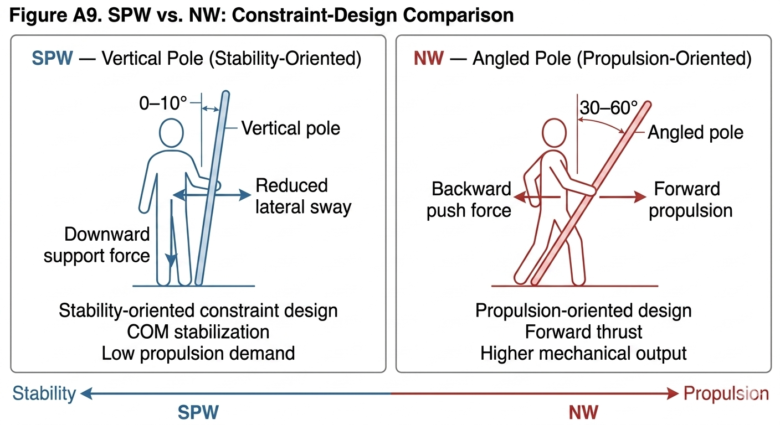 SPW is built on three core principles:
1. Vertical support for stability
Poles are placed nearly vertical, providing predictable support points.
2. Minimal propulsion, maximal balance
Unlike Nordic Walking, SPW does not use poles for pushing. The goal is stability, not speed.
3. Constraint based reorganization
The poles act as external constraints that guide the system toward safer, more efficient solutions.
These principles make SPW a unique tool for studying and improving gait.
3. How SPW Reshapes Stability
Stability is the foundation of SPW.
Vertical poles:
• reduce lateral sway
• stabilize the center of mass
• provide a reliable support structure
• lower cognitive load for balance
This creates a walking mode that is safer and more predictable, especially for individuals with reduced balance capacity.
4. How SPW Shapes Variability
SPW does not eliminate variability—it structures it.
The poles:
• suppress unnecessary fluctuations
• support consistent rhythm
• reduce chaotic micro adjustments
• create a stable attractor for walking
This structured variability is ideal for rehabilitation and gait training, where too much or too little variability can be problematic.
5. How SPW Influences Switching Behavior
SPW interacts directly with the mechanisms of gait transitions.
By stabilizing the COM and reducing metabolic cost, SPW:
• delays premature switching
• clarifies sensory cues
• reduces noise in the SCAN loop
• expands the safe range of walking speeds
SPW effectively reshapes the liminal zone, making transitions smoother and more controlled.
6. SPW as a Multi Layer Intervention
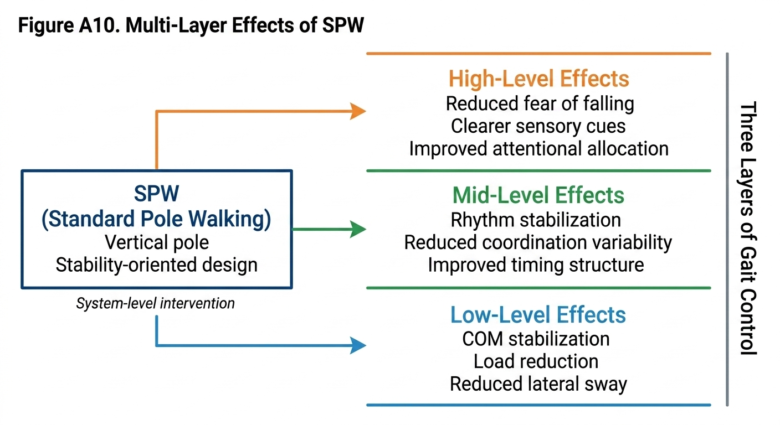 SPW influences all layers of the gait hierarchy:
Low level (Biomechanical)
• additional support points
• reduced joint loading
• stabilized COM trajectory
Mid level (Coordination)
• improved rhythm
• reduced unnecessary variability
• strengthened left–right alternation
High level (Cognitive–Perceptual)
• reduced fear of falling
• clearer sensory feedback
• lower cognitive demand
This multi layer influence is what makes SPW a powerful system, not just a technique.
7. Why SPW Is a Designed System, Not an Accidental Technique
SPW embodies the principles of:
• constraint based optimization
• hierarchical control
• structured variability
• perceptual–cognitive integration
It is a deliberately designed intervention that leverages the natural logic of human movement.
SPW shows us that by adjusting constraints—not by forcing movement—we can reorganize the entire system.
8. Conclusion: SPW as a Window into Human Movement
Standard Pole Walking is more than a practical tool. It is a living demonstration of how human gait works:
• how stability emerges
• how variability is shaped
• how transitions occur
• how constraints guide optimization
• how perception and action form a unified loop
Through SPW, the hidden structure of gait becomes visible.
This is why SPW is not just a method—it is a designed movement system grounded in the science of human locomotion.
📘 Appendix Text:
SPW as a System-Level Intervention
Standard Pole Walking (SPW) is not an intervention that acts on a single body segment or a single control layer. Instead, it functions as a system-level intervention that simultaneously influences all three layers of gait control—Low, Mid, and High.
The defining feature of SPW, the vertical pole, serves as an external constraint that provides stability outside the body. Its effects propagate across layers, influencing the following three domains.
1. Effects on the Low-Level (Biomechanical) Layer
The low-level layer governs physical stability and reflexive control. SPW exerts its most direct influence here.
• COM stabilization
The vertical pole acts as an external support point, reducing mediolateral COM oscillation.
• Load reduction
Upper-limb support decreases lower-limb loading, enhancing cycle-to-cycle stability.
• Reduced lateral sway
This improves fundamental gait stability and suppresses fluctuations when entering the liminal zone.
Improvements at the low level strengthen the foundation of functional integrity.
2. Effects on the Mid-Level (Coordinative) Layer
The mid-level layer governs rhythm, timing, and coordination. The stabilizing effects of SPW influence this layer indirectly but powerfully.
• Rhythm stabilization
Reduced COM oscillation leads to a more stable gait rhythm.
• Improved timing structure
Upper–lower limb coordination becomes easier, producing more consistent timing.
• Reduced coordination variability
This strengthens gait pattern formation.
Mid-level improvements directly enhance functional quality.
3. Effects on the High-Level (Cognitive–Perceptual) Layer
The high-level layer governs attention, perception, and intention. SPW also produces clear effects here.
• Fear-of-falling reduction
The presence of an external support point increases psychological stability.
• Sensory cue clarity
Tactile and proprioceptive cues from pole contact enhance body-position perception.
• Improved attentional allocation
Increased stability frees attentional resources for tasks beyond basic gait control.
High-level improvements enhance adaptability and strategic control of gait.
4. Integrated Effects as a System-Level Intervention
The defining characteristic of SPW is that it acts on the Low, Mid, and High layers simultaneously.
• Stabilization at the low level
• Improves coordination at the mid level
• Reduces cognitive load at the high level
This produces a cross-layer cascade effect.
Such a structure demonstrates that SPW is not merely a walking aid but an intervention that reorganizes the entire gait-control system—a true system-level intervention.
5. Relation to Appendix Figure S4
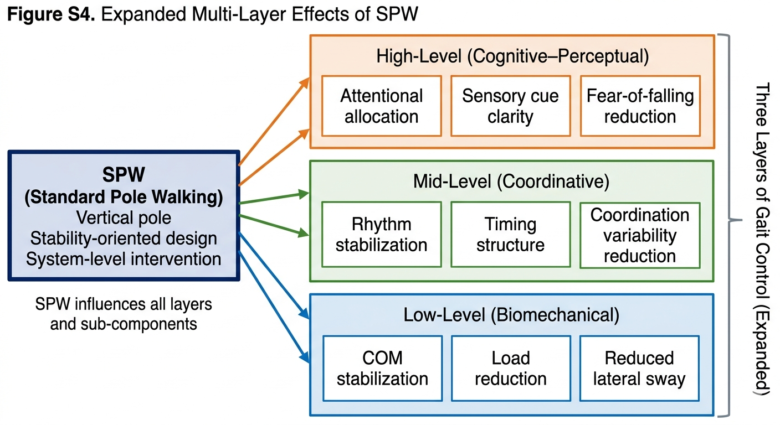 Appendix Figure S4 visually illustrates how SPW influences the sub-components within each layer:
• Low-level: COM, load, sway
• Mid-level: rhythm, timing, coordination
• High-level: attention, perception, psychological stability
The direct arrows from SPW to each sub-component provide decisive evidence that SPW’s influence is cross-layer and systemic.
*** Link ***
→ Opening Article
→ Article 1
→ Article 2
→ Article 3
→ Article 4