TOPICS – Key Themes and Research Directions in Standard Pole Walking
***For an overview of how to navigate the English content (TOPICS, Articles, and Papers), please visit the English Gateway Page. → Link to English Gateway Page ***
This page provides an overview of the major topics, research questions, and conceptual foundations related to Standard Pole Walking (Japanese Method). It also serves as a hub that connects to detailed articles, comparative materials, and the ongoing English language series on switching, variability, and system dynamics.
1. Research Topics in Standard Pole Walking
Below are the core research themes currently being developed. Each topic links to a dedicated page or article.
Topic 1: The Biomechanics and System Dynamics of Standard Pole Walking
How pole assisted gait modifies stability, load distribution, and switching behavior. → Link to 「Topic 1」 page
For a narrative introduction to these concepts, see Article 1 in the English Series. →「 Article 1 – The Boundary Between Walking and Running」
Topic 2: Switching Mechanisms in Human Gait — Variability, Constraints, and Liminal Zones
A unified framework for understanding transitions between walking and running. → Link to 「Topic 2」 page
For a story based explanation of variability and SCAN, see Article 2 in the English Series. → 「Article 2 – Variability, Stability, and the SCAN Framework」
Topic 3: Designing Assistive Walking Systems — Hierarchy, Optimization, and Practical Applications
From theoretical models to real world pole assisted walking techniques. → Link to 「Topic 3」 page
For a narrative exploration of hierarchy and optimization, see Articles 3 and 4 in the English Series. →「 Article 3」 /「 Article 4」
Related Series
The Story of Switching – English Edition → Link to English Series Index Page
2. What Is Standard Pole Walking (Japanese Method)?
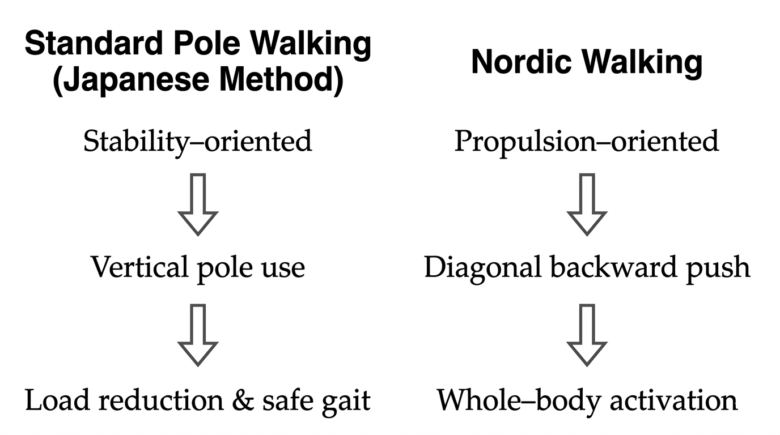
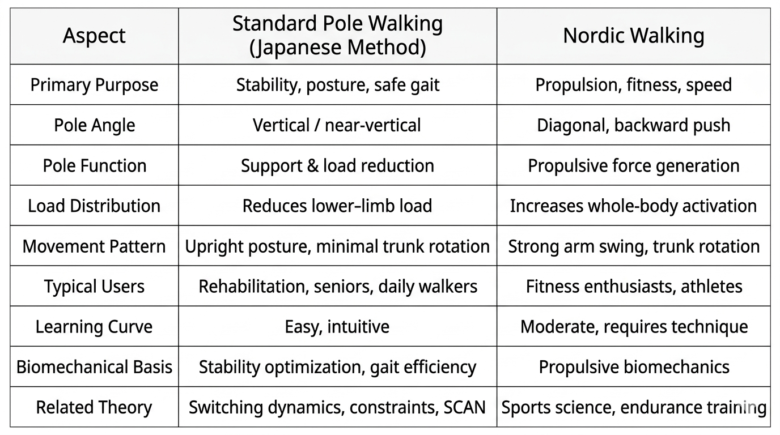
Standard Pole Walking is a Japanese pole assisted walking method that differs fundamentally from Nordic Walking in:
• Purpose (stability oriented vs propulsion oriented)
• Technique (pole angle, timing, load distribution)
• Biomechanical principles
• Underlying theoretical framework
It is used in rehabilitation, gait improvement, fall prevention, and general wellness, and forms the practical foundation for the theoretical work presented in the English series.
3. Comparison: Standard Pole Walking vs Nordic Walking
A. Conceptual Diagram
 B. Detailed Comparison Table
4. Background and Theoretical Foundations
Standard Pole Walking connects naturally with broader theoretical frameworks, including:
• Switching dynamics (walking ↔ running)
• Variability and liminal zones
• Constraint based optimization
• Hierarchical reorganization
• SCAN (Order → Liminal → Order)
• Viable System Model (Beer)
These frameworks are explored in depth in the English series.
5. Links to the English Series and Papers
• Opening Article – The Story of Switching
• Article 1 – Looking at the Boundary Between Walking and Running
• Full Papers (English Edition)
• Appendices and Figures
→ Link to 「English Series Index」 Page
6. For International Readers
This TOPICS page is designed to provide a clear starting point for readers outside Japan. For terminology used in the English series, please refer to the note below.
Note on Terminology
In this site, the term Pole Walking refers to Standard Pole Walking (Japanese Method), which is distinct from Nordic Walking.
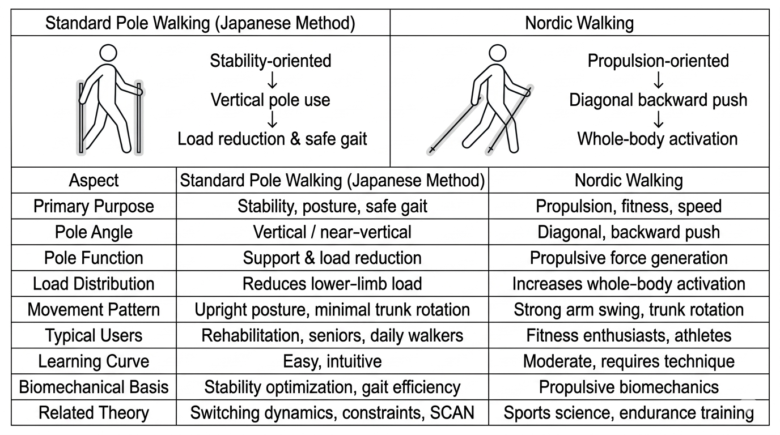 Figure 1. Comparison between Standard Pole Walking (Japanese Method) and Nordic Walking.
Legend. This figure provides a conceptual and technical comparison between Standard Pole Walking (Japanese Method) and Nordic Walking. The upper diagram highlights the fundamental difference in purpose: Standard Pole Walking is stability oriented, using near vertical poles to reduce lower limb load and support safe gait, whereas Nordic Walking is propulsion oriented, using diagonal backward pole pushes to increase whole body activation. The lower table summarizes key distinctions in purpose, pole angle, biomechanical function, movement patterns, user groups, and theoretical foundations. Together, these elements clarify why the two methods represent different walking systems with different goals and underlying principles.
For the technical and mathematical foundations of this framework, please refer to the Papers section. → 「Paper A」 /「 Paper B」
*** Link ***
→ Link to English Series Index
→ Link to Paper A
→ Link to Paper B
→ Link to Appendices