🌍 Article 1
Looking at the Boundary Between Walking and Running
How liminal zones reveal the hidden structure of human gait
1. Introduction: The Moment When Walking Stops Feeling Like Walking
There is a moment—subtle, but unmistakable—when walking no longer feels efficient. Your steps become slightly heavier, your breathing changes, and your body begins to hint:
“Maybe it’s time to run.”
This moment is not simply about speed. It is the entrance to a liminal zone, a boundary region where walking becomes unstable and running becomes increasingly attractive.
Understanding this zone is the key to understanding human gait as a dynamic, self organizing system.
2. Walking and Running as Attractors
Human movement does not operate like a machine with fixed gears. Instead, it behaves like a system with attractors—stable patterns that the body naturally falls into.
• Walking attractor Efficient at low speeds, stable, low variability.
• Running attractor Efficient at higher speeds, stable, rhythmic, elastic.
Between them lies a region where neither attractor is fully stable. This is the liminal zone.
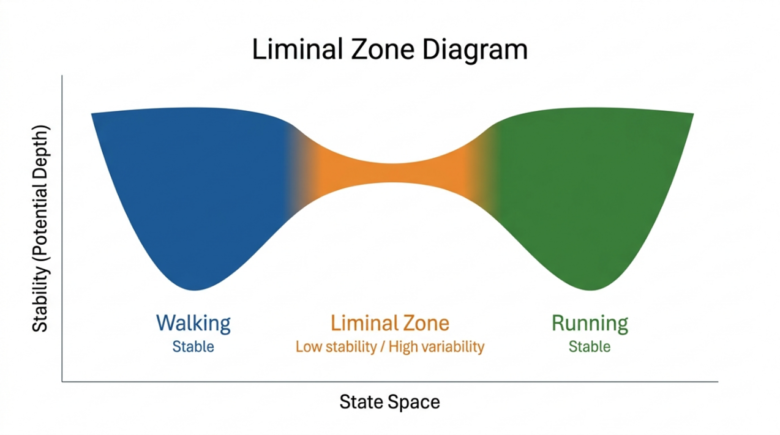 3. What Happens in the Liminal Zone
In the liminal zone, the system begins to “test” alternatives. Several characteristic changes appear:
• Step timing becomes irregular
• The center of mass oscillates more
• Metabolic cost rises
• Perception of effort increases
• Sensory cues become ambiguous
The body is not failing—it is exploring.
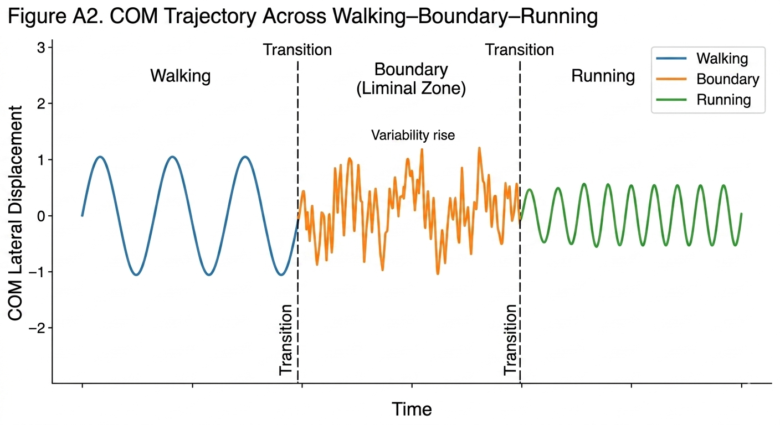 Variability increases because the system is searching for a more efficient solution.
4. Variability as Exploration, Not Noise
Variability is often misunderstood as error. But in human gait, variability is a functional tool.
It allows the system to:
• probe the stability of the current attractor
• evaluate alternative movement patterns
• adjust to environmental constraints
• prepare for a potential transition
In the liminal zone, variability becomes structured and meaningful.
5. Why Switching Happens When It Happens
Switching from walking to running occurs when:
• walking becomes inefficient under current constraints
• variability reveals a more stable alternative
• sensory cues align toward running
• the system reorganizes into a new attractor
This is not a conscious decision. It is a system level reconfiguration driven by biomechanics, perception, and cognition.
6. How Standard Pole Walking Changes the Boundary
Standard Pole Walking (Japanese Method) reshapes the liminal zone.
By stabilizing the center of mass and reducing unnecessary variability, SPW:
• delays the onset of instability
• lowers the metabolic cost of walking
• clarifies sensory cues
• reduces the need for early switching
In other words, SPW modifies the stability landscape itself.
7. Conclusion: The Boundary as a Window into the System
The boundary between walking and running is not a line—it is a landscape. A region where stability, variability, and perception interact in complex but meaningful ways.
By studying this boundary, we gain insight into:
• how movement systems adapt
• how transitions emerge
• how tools like poles reorganize gait
• how humans maintain stability in a changing world
This is the first step in understanding gait as a unified, dynamic system.
*** Link ***
→ Opening Article